
 UA
UA  EN
EN 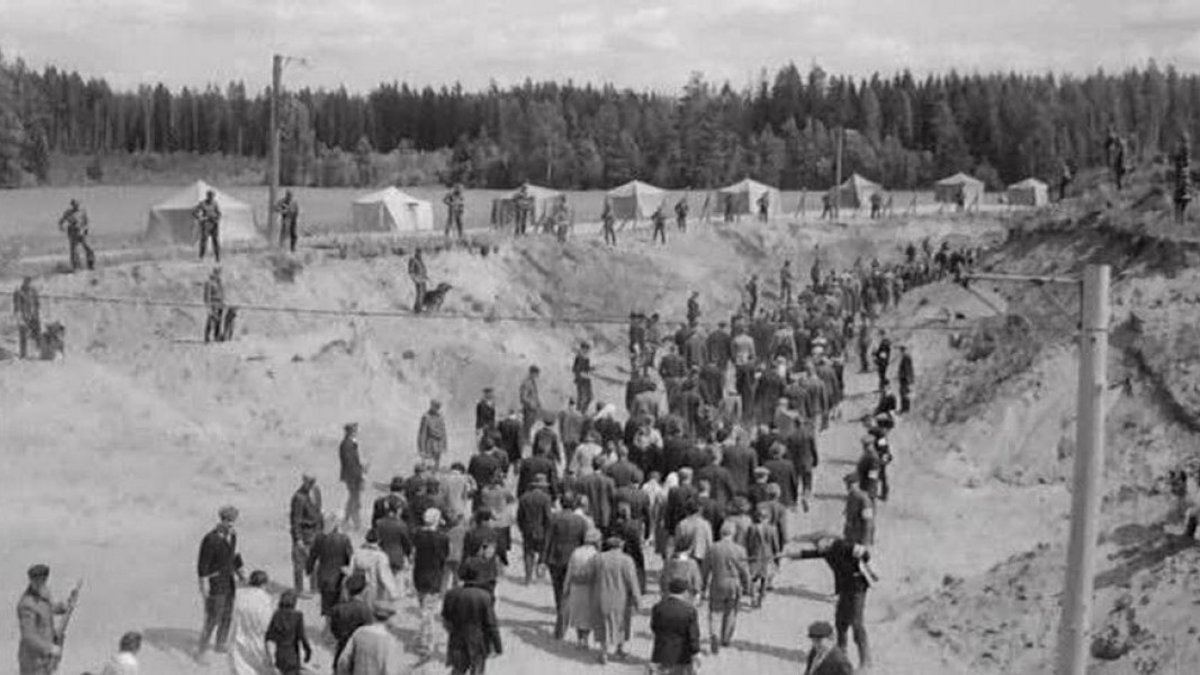
One of the symbols of the Holocaust in Ukraine has become Babyn Yar in Kyiv, a place of memory and necropolis of about 100,000 people shot by the Nazis in 1941–1943. Among them are Jews, Roma, Red Army soldiers, communists, underground members of the Organization of Ukrainian Nationalists, prisoners of the Syretsk concentration camp, “saboteurs”, curfew violators and even patients of the I. P. Pavlov psychiatric hospital.
In response to acts of sabotage by Soviet partisans, the Jews of Kyiv were shot by the occupiers at Babyn Yar on September 29–30, 1941. At that time, the Nazis killed 33,771 people, making it one of the largest mass executions of Jews during the Holocaust.
On September 27, 1941, the printing house of the Eastern Front produced 2,000 wall posters calling on the Jews of Kyiv to appear at the corner of Degtyarivska and Melnykova Streets (now Yurii Ilyenko Street), taking with them documents, money and valuables, warm clothes and underwear, as well as food for three days. The next day, the Ukrainian police posted announcements around the city. At the same time, a rumor was spread that Jews were being rounded up for resettlement.
The “Road of Death” ran from Lukyanivska Square along Melnykova Street to the first gate of the Jewish Cemetery, then to Kahatna (now Gareth Jones Street), then along Lagerna (now Dorohozhytska Street). Jews were forced to take off their shoes and undress, their documents, valuables, and food were taken away. Before the execution, people were beaten, threatened with dogs, and humiliated in every way. Already on the spot, several firing squads killed Jews with a shot to the back of the head. The shootings lasted two days. On the evening of September 30, 1941, the area near the ditch was blown up, and about 100 prisoners of war from the Syretsk camp leveled the grave, hiding the atrocities.
The killings at Babyn Yar continued until the fall of 1943 and stopped only a few days before Soviet troops retook control of Kyiv.
As the Red Army approached Kyiv in August 1943, the occupiers launched a cover-up operation to hide the traces of mass executions. To do this, the Nazis sent several hundred prisoners from the Syretsk concentration camp, located near Babyn Yar, to dig up mass graves and burn the remains of the dead.
In 1976, a monument to “Soviet citizens and prisoners of war soldiers and officers shot by the fascists in Babyn Yar” was opened in Babyn Yar. On September 29, 1991, on the 50th anniversary of the mass shooting, a monument to Jews – victims of the Nazi regime in the form of a seven-candlestick (menorah) were erected in Babyn Yar. In March 2007, the National Historical and Memorial Reserve “Babyn Yar” was established on the territory of Babyn Yar. In total, as of 2021, there are more than 30 monuments on the territory of the reserve, including: a monument to children shot in Babyn Yar; a Roma caravan as a symbol of the extermination of the Roma population; a monument to prisoners of the Syretsk concentration camp, etc.