UA
UA  EN
EN 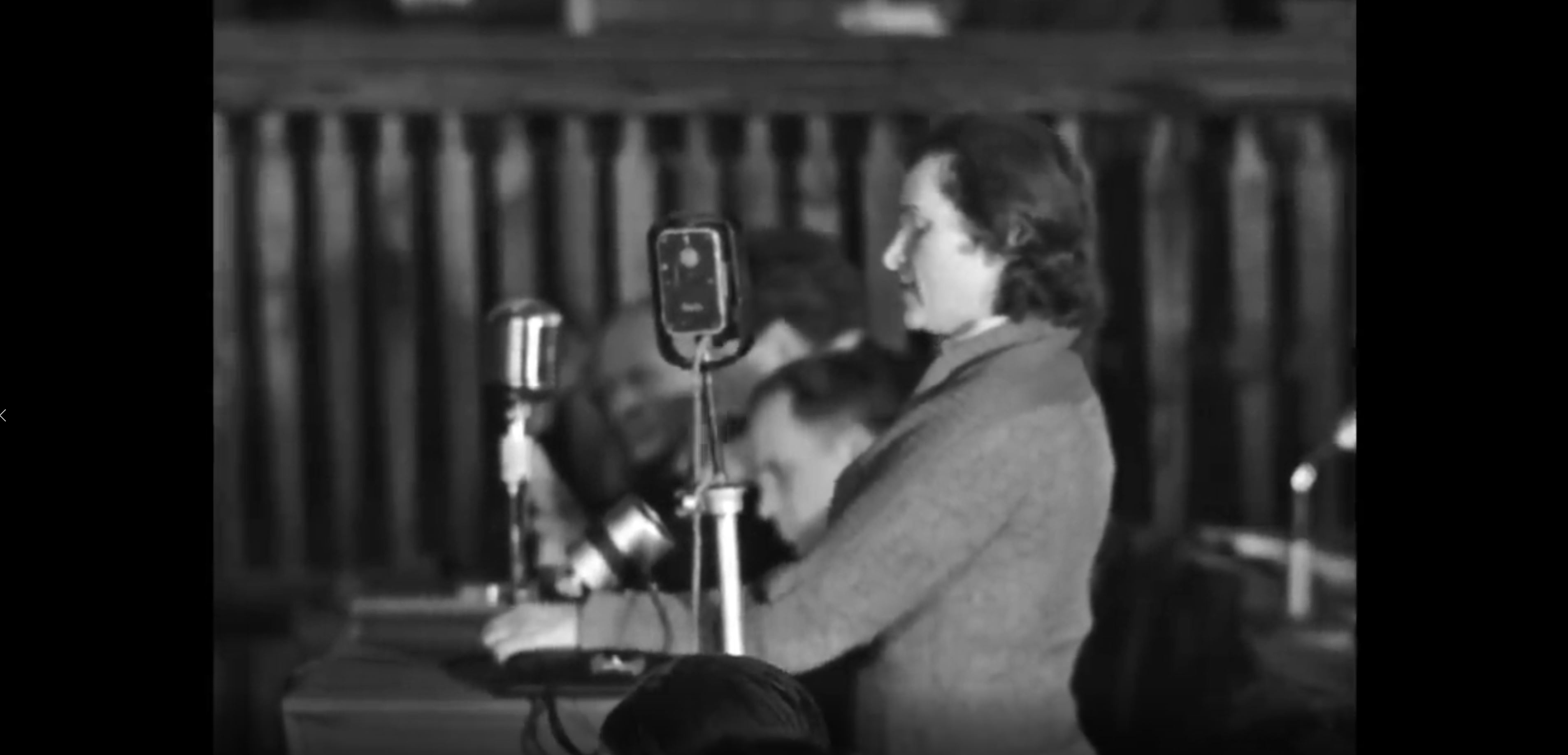
January 12, 1946
Protocol of interrogation of witness Pronicheva Dina Mironivna
[...] Pronicheva Dina Myronivna, born in 1911, a citizen of Kyiv, lives at 41 Vorovsky St., apt. 7a, Jewish by nationality, secondary education, artist by profession, non-partisan, no criminal record.
In essence, it showed:
Before the start of the Patriotic War [i. e., World War II – ed.], I lived with my family in the city of Kyiv and worked as an artist at the Kyiv Central Puppet Theater. I am Jewish by nationality; my maiden name is Mstislavska. In 1932, I married Pronichev, he is Russian by nationality.
At the beginning of the Patriotic War our family consisted of me, my husband Pronichev Viktor Alexandrovich, his mother Pronicheva Kateryna Antonyvna and two children: daughter Lydia, who was then 3.5 years old, and son Volodymyr, who was then 1.5 years old. We lived then on Vorovsky St. (now Bulvarno-Kudryavska Street), building 41, apt. 27.
My relatives – father, mother, two brothers and a sister – also lived in Kyiv, at 27/2 Turgenevska Street (now Oleksandra Konyskyi Street). At the beginning of the war, my brothers were drafted into the army.
Due to several reasons beyond our control, neither my family nor my relatives’ families were evacuated from Kyiv.
On September 19, the Germans stormed Kyiv. On September 28, an order was posted throughout the city, according to which the entire Jewish population was to arrive at Degtyarevska Street by 8 a. m. on the next day, that is, on September 29. The order emphasized that it was necessary to take all warm and valuable things with them; failure to appear was punishable by shooting.
Some of my friends advised me to flee Kyiv, others, on the contrary, persuaded me, saying that since I was married to a Russian, the Germans would not touch me.
On the 28th I went to my relatives, they were completely confused and asked me not to leave them. I stayed with them and the next morning I went with them to Degtyarivska Street.
No one knew for sure the purpose of concentrating the entire Jewish population in the Degtyarivskaya Street area. Almost no one assumed that innocent people would be killed there in such a huge mass. Everyone had the idea that the Germans were going to take the Jewish population somewhere. This idea was also reinforced by the fact that the order required that they take their belongings with them.
We left the house at seven in the morning, from Turgenevska we went out onto Artema Street (now Sychovykh Striltsiv Street), and then along Melnikova Street (now Yurii Ilyenko Street) to the Jewish cemetery. There were a huge number of people: men, women, old people, children, mothers carrying babies in their arms. Many carried things on themselves, others carried them in wheelbarrows, there were many carts with things, etc.
No one controlled this movement until the gates of the Jewish cemetery on Degtyarivskaya Street. A traffic jam formed at the gates of the cemetery; there were wire fences and anti-tank hedgehogs. Germans in helmets, armed with rifles, stood near these wire fences and hedgehogs. Everyone was allowed through the wire fences, but no one was allowed out, except for the carts on which things were bought.
People entering through these barriers walked forward 50 or 100 meters, then turned left, so the Jewish cemetery remained on the right side. There, near the fence, everyone’s belongings were taken away and piled right next to the fence, with food placed separately and clothes placed separately. The Germans immediately took away valuable things such as fur coats, watches, rings, and earrings and divided them among themselves. From the place where they put their things, people were directed to the right. People walked forward through the grove. From the grove, the road led downhill. At the end of this slope, Germans stood with clubs and dogs. The Germans formed a corridor and beat people. Anyone who tried to bypass this corridor was turned back by the Germans with dogs standing on the sidelines. When people left this corridor, they immediately fell into the hands of the police, who immediately stripped them on a large platform. The naked people were driven one by one up the slope. People reached the crest of the mountain and there emerged into a gap in the sand wall to the ravines.
I was also walking this road with my family. I had no belongings; near the place where they were putting things away, they took off my white fur coat; then, moving on, I lost my family in the crowd. When I passed through this living corridor formed by the Germans, the Germans beat me just like they beat everyone else. When I approached the corridor, I heard machine gun fire, I realized that people had been brought here to be destroyed, and I decided to try to escape.
I threw away my passport, leaving behind some documents, namely: a trade union card, a workbook, which only had my last name written on them, and no nationality indicated. After I fell into the hands of the police, I immediately told the first policeman in pure Ukrainian that I was not Jewish, that I was Ukrainian and had accidentally ended up here; at the same time, I showed him my documents. He suggested that I sit near the place where the Jewish population was being undressed, and told me to wait until evening, and in the evening, I would be able to go home. I joined a group of people who happened to be there. That way, they didn’t undress me. So I stayed there until the evening.
During that day I saw terrible pictures: people went crazy before my eyes, turned gray, there were frantic screams and groans all around, machine guns were firing all day. I saw the Germans taking children from their mothers and throwing them off a cliff into a ravine. In the evening, a car drove up to our group, and a German officer got out of it. After asking what kind of group it was, he ordered us all to be shot, explaining that people who, although not Jews, had seen everything that happened here could not be let out of here. They lined up us up and drove us up.
Having entered the gap in the sand wall, we found ourselves on a narrow path at the edge of a precipice. From the opposite side of the ravine, the Germans began shooting us with machine guns.
Our group consisted of about 25–30 people. I saw people next to me fall down the cliff after the shootings. Even before I was shot, I threw myself down the cliff. I fell on the corpses of the people who had just been shot and pretended to be dead. I heard the Germans coming down and shooting the wounded. I was afraid to move, a policeman came up to me, saw that there was no blood on me, called the German, saying that I seemed to be still alive. I held my breath; one of them kicked me so that I fell over and lay face up. The German put one foot on my chest and the other on my hand. After making sure that I did not react to this, they left. A wound formed on my arm, and the scar is still there.
Some time passed, and they began to cover us with earth. The layer of earth was small, and I managed to get out. Already in the dark, I quietly approached the wall of the cliff and climbed up with difficulty. I reached the edge of the cliff near the area where they were undressed before the shooting. As I was climbing up the cliff, a boy called out to me, who also remained alive. For two days, this boy and I tried to get out of “Babyn Yar.” The first day I hid in a tree, and the boy sat in the bushes; the second day I sat in a garbage pit. On the morning of the third day, the boy, who was trying to get to Kurenivka, was killed. I heard two shots, but I didn't see who shot him.
On the morning of the third day, I went to a barn. The landlady found me there. I hid the whole story of my escape from “Babyn Yar” and told her that I was leaving the trenches, asking to show me the way to the city.
She seemed to agree to do this, winked at her 17-year-old son, who disappeared somewhere and a few minutes later appeared with a German officer and, pointing at me, said: “Here, sir, Judas.” The German ordered me to follow him. We walked about 50 steps. The German officer led me to one of the houses where several Germans were sitting and having breakfast. He ordered me to sit on the floor, and ordered the Germans who were sitting there not to let me out.
All the Germans had breakfast and left, leaving one to watch me. This German made me clean one room, then another. After a while, the same German officer brought two more young Jewish girls, and then he took the three of us to “Babyn Yar” and brought us to the place where I had watched people undress four days before. It turned out that I had crawled not far from the place of the shootings. We arrived very quickly at this so-called “changing room.” We were joined by a group of old people and children who were already sitting on the site. We waited for several hours. Cars with Soviet prisoners of war arrived at this place to fill up the ravines with corpses. We were put in this car and taken away. First, we were taken to the garages that were located opposite the Jewish cemetery, but they did not accept us there and took us further. There was one nurse in this group, Lyuba Shamin. We agreed with her that if we had the opportunity, we would jump out of the car on the move. So, we did. In the Shulyavka area, I jumped out of the car first. I told the people around me that the German who had offered to give me a ride didn’t understand me and didn’t stop where I should have, so I had to jump out on the move. Lyuba Shamin also jumped out of the car not far from me, and we headed to my cousin’s wife, a Polish woman named Falinska, where, after spending the night, we went to Darnytsia to see my friend Lyuba.